
Kangen Water 2.5 vs. Vinegar: Same pH, Different Cleaning Roles
A peaceful home begins with thoughtful care—including what we use to clean it. If you are exploring eco-friendly house cleaning in Roseville, Rocklin, or Lincoln, you may have heard about both vinegar and Kangen water.
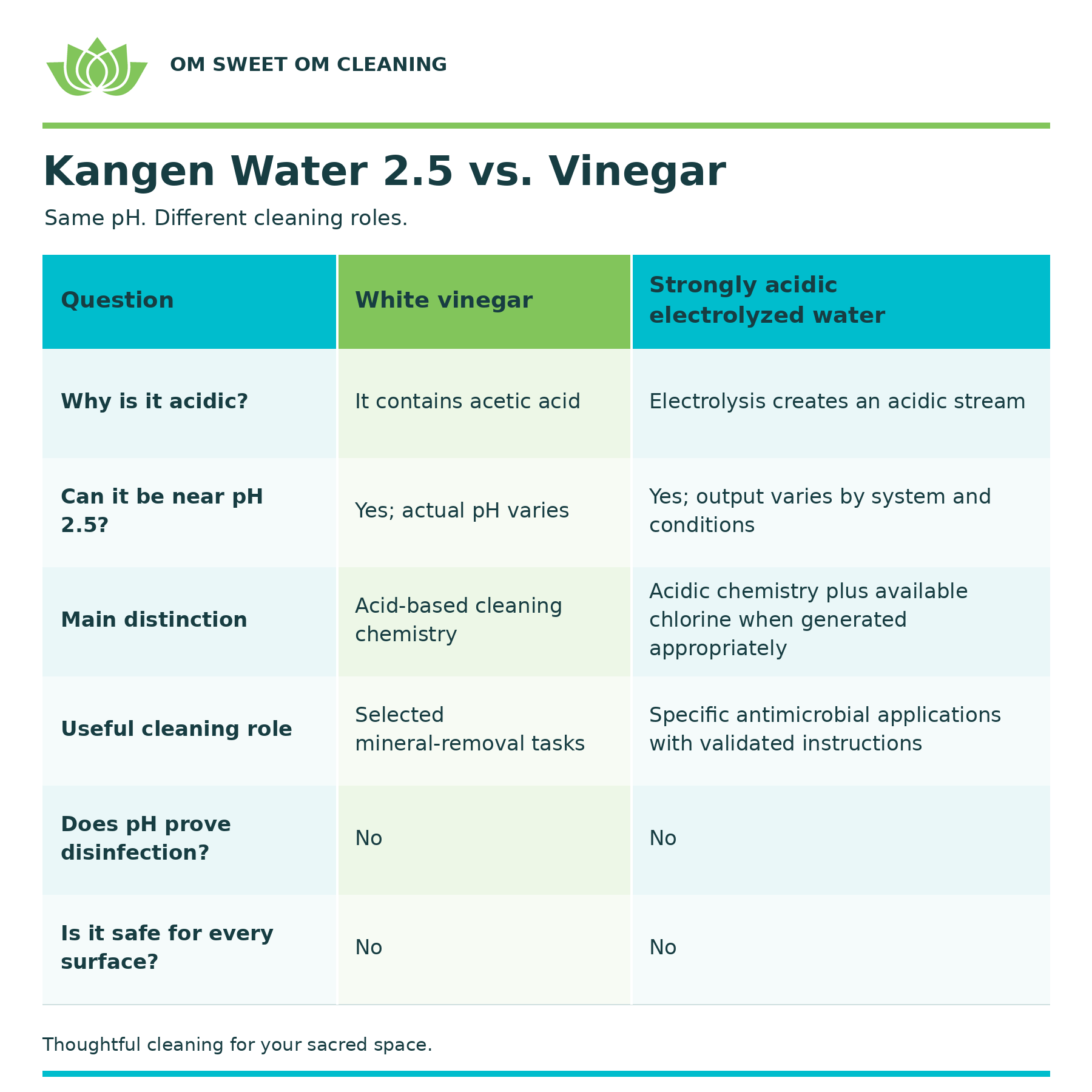
Here is a question we love: If Kangen strongly acidic water has a pH of about 2.5, and white vinegar can also have a pH near 2.5, are they essentially the same?
No. They can share a similar pH while having different ingredients, different cleaning abilities, and different precautions.
Think of pH as one piece of a product’s story. It tells us about acidity, but it does not tell us everything about what is in the bottle, whether it will disinfect, or whether it belongs on your beautiful countertop.
At Om Sweet Om Cleaning, our approach to caring for your sacred space includes understanding those differences. Thoughtful cleaning means matching the method to the mess, the material, and the people who live there.
What Does pH 2.5 Mean?
The pH scale describes how acidic or alkaline a water-based solution is. In everyday terms, pH 7 is neutral, values below 7 are acidic, and values above 7 are alkaline.
A pH of 2.5 is distinctly acidic. The scale is logarithmic: each whole-number step represents a tenfold change in hydrogen-ion activity. A solution at pH 2.5 has about ten times the hydrogen-ion activity of one at pH 3.5. Source: USGS
However, pH is not the same as the amount of acid in a bottle.
Vinegar labeled “5% acidity” describes its acid content. It does not mean pH 5. Heinz, for example, labels its ordinary distilled white vinegar as diluted to 5% acidity. Source: Heinz
Also, vinegar does not always measure exactly 2.5. Its pH depends on the product and dilution. One laboratory study measured undiluted vinegar at pH 2.58—close to the number people often mention in this comparison. Source: household antimicrobial study
The useful takeaway: a pH reading helps us understand a liquid, but it cannot replace its ingredient information or directions.
What Is the Difference Between Vinegar and Kangen 2.5 Water?
Vinegar: Acetic Acid for Certain Cleaning Tasks
Vinegar is a water-based solution containing acetic acid. For household cleaning, its familiar role is helping loosen mineral deposits on acid-compatible materials.
That makes it a possible tool for certain hard-water spots or descaling tasks when the surface or appliance manufacturer permits it. It is affordable and easy to find, although its sharp smell may be unwelcome in a scent-sensitive home.
Vinegar can have antimicrobial effects under laboratory conditions. But laboratory results do not make a pantry bottle a dependable disinfectant for every household germ. In the study mentioned above, effectiveness varied with the organism and treatment conditions. Source: household antimicrobial study
EPA does not review common household vinegar for effectiveness against the virus that causes COVID-19. When disinfection is necessary, choose a product with appropriate verified directions rather than relying on vinegar’s acidity. Source: EPA
Kangen 2.5: Thoughtful Care for Your Home
Caring for your home is about creating a space that feels fresh, peaceful, and welcoming. Part of that care is understanding which cleaning tools fit each purpose.
Often called “Kangen 2.5,” Strong Acidic Water is produced by certain Enagic machines at approximately pH 2.4–2.7. It is a separate output from the alkaline water intended for drinking.
When produced with the appropriate chloride-containing inputs, acidic electrolyzed water can contain hypochlorous acid and other active chlorine compounds with antimicrobial activity. Its effectiveness depends on the solution’s composition, concentration, freshness, and contact time—not simply its acidic pH. Research on electrolyzed water does not establish that every machine-generated batch is an effective disinfectant.
Where might it fit into your home-care routine? When both the machine instructions and surface-care guidelines allow its use, possible applications include:
Bathroom surfaces: Wiping compatible, nonporous sink and toilet exteriors after removing visible soil.
Frequently touched areas: Caring for compatible door handles and other hard surfaces.
Kitchen surfaces: An additional surface-care step on compatible counters after food residue and grease have been removed.
Washable household items: Treating compatible hard, nonporous items according to their care instructions.
These are potential surface-care applications, rather than a guarantee of sanitizing or disinfecting. When verified disinfection is needed, use an appropriate EPA-registered product and follow its directions.
Vinegar and Kangen 2.5 serve different purposes. Vinegar’s acetic acid can help loosen mineral deposits on acid-safe surfaces. Strong Acidic Water has a different chemistry; a similar pH does not make the two interchangeable.
Keep Kangen 2.5 separate from vinegar, essential oils, and other cleaners. It is not drinking water, and its acidity makes surface compatibility especially important. Avoid using it on marble, limestone, or other acid-sensitive materials.
How Does a Kangen Machine Produce pH 2.5 and pH 11.5 Water?
A compatible Kangen machine uses electrolysis to produce two separate streams of water—one acidic and one alkaline.
After filtration, water passes through a chamber containing electrically charged plates and separating membranes. Reactions near the positive electrode make one stream more acidic, while reactions near the negative electrode make the other more alkaline. The streams leave through separate hoses.
With the appropriate strong-water setting and manufacturer’s electrolysis enhancer, compatible models can produce:
Actual readings depend on the machine, source water, and operating conditions.
These numbers sit on opposite sides of neutral pH 7. Although 2.5 + 11.5 equals 14, the machine does not literally divide a “total pH of 14.” The pH scale measures each stream’s acidity or alkalinity; it is not an amount that gets split between them.
The acidic stream can also contain chlorine-based antimicrobial ingredients generated from chloride-containing inputs during electrolysis. Its potential disinfecting ability depends on those ingredients and their concentration—not simply on reaching pH 2.5.
Always follow the instructions for your specific machine and enhancer. Neither strong-water stream is intended for drinking.
Why the Same pH Does Not Mean the Same Performance
Imagine two clear bottles sitting beside your sink. Both test near pH 2.5. You still need to know their ingredients and intended uses before choosing one.
A pH strip cannot identify the acid, measure available chlorine, or tell you how long a surface must stay wet to achieve a particular antimicrobial result.
Vinegar also contains a reserve of acetic acid beyond the hydrogen ions reflected in its pH reading. Chemists call the broader acid measurement “titratable acidity.” Two liquids with matching pH can therefore behave differently as they react with a deposit.
Researchers studying acetic acid tested another acid solution at a comparable pH to investigate whether acidity alone explained bacterial killing. Their results reinforce that the identity of the chemical matters, too. Source: acetic acid research
For homeowners, this is a reason to be curious about cleaning claims. “It has the same pH” is the beginning of a comparison, not proof of equivalence.
How Is Acidic Electrolyzed Water Used in Japanese Hospitals?
There is published evidence of acidic electrolyzed water being used in Japanese medical settings, particularly for disinfecting certain flexible endoscopes.
A 2022 Japanese multicenter study examined 90 endoscopes used in ear, nose, and throat care. Staff manually cleaned the instruments before using a dedicated Cleantop KD-1 washer-disinfector. The system used an effective chlorine concentration of 10–40 parts per million and a 90-second disinfection cycle. Researchers reported effective reprocessing under the studied conditions. Source: Okano and colleagues, PLOS ONE
This supports a specific medical application. It does not establish that every Japanese hospital uses Kangen machines, or that a home bottle at pH 2.5 is equivalent to the studied system.
The hospital findings are encouraging and show what electrolyzed water can do under carefully managed conditions. Cleaning, specialized equipment, the right chlorine concentration, and a timed treatment all played a part. Keeping those steps in mind helps us understand how the findings may relate to caring for our homes.
Are There Surfaces Where These Products Should Not Be Used?
Yes. A natural origin or a water-based formula does not guarantee compatibility.
Natural Stone
Avoid vinegar on marble, limestone, and travertine. Acids can etch these materials, leaving dull spots that are actual surface damage. The Natural Stone Institute recommends neutral cleaners for routine care. Do not assume granite or its sealer tolerates vinegar either; consult the supplier. Sources: Natural Stone Institute and countertop guidance
Because strongly acidic electrolyzed water is also acidic, our conservative recommendation is to keep it off acid-sensitive stone unless the stone supplier explicitly approves the specific solution.
Wood, Grout, Decorative Finishes, and Electronics
For either liquid, obtain material-specific approval before using it on wood floors, waxed surfaces, cement-based grout, specialty metal finishes, or delicate coatings. The finish can matter as much as the material underneath.
A cautious approach is especially worthwhile around:
Wood floors and furniture: choose the cleaner recommended for the finish and control moisture.
Cement-based grout: choose a compatible grout cleaner rather than making acidic products your routine method.
Decorative hardware and appliance finishes: check coating compatibility before applying acids or oxidizing solutions.
Electronics: follow the device maker’s instructions and keep liquids away from openings.
These are conservative care recommendations, not a claim that every material reacts identically. For electrolyzed disinfectants, CDC specifically advises checking equipment-manufacturer compatibility. Source: CDC
Which Should You Choose for Your Cleaning Task?
Start by asking what you are trying to remove.
Mineral buildup: Consider a manufacturer-approved descaler. Vinegar may fit some acid-compatible applications; strongly acidic water is not automatically an equivalent substitute.
Everyday dust and fingerprints: Start with a surface-safe cleaner, clean cloths, and careful wiping. Neither pH 2.5 liquid needs to be the default for your whole house.
Greasy kitchen soil: Choose an appropriate grease-removing cleaner. Acidity alone does not make either option a complete kitchen degreaser.
A situation requiring disinfection: Choose a disinfectant or validated system with directions for the intended surface and organism. EPA advises reading registered-product labels for the approved use site and target pathogen. Source: EPA
Keep vinegar separate from bleach and chlorine-containing electrolyzed solutions. Do not add vinegar, essential oils, or other cleaners to generated acidic water. Mixing changes the formulation and can introduce hazards; use each product according to its own instructions.
What Does This Mean for Eco-Friendly House Cleaning?
For us, mindful cleaning begins before we open a bottle. We look at the surface, the soil, and the household’s preferences. We consider fragrance sensitivity, product directions, and the method needed to do the job well.
Sometimes the most thoughtful choice is a gentle cleaner and a careful wipe. Sometimes a mineral deposit needs a targeted treatment. Sometimes disinfection is appropriate. Each situation deserves its own decision.
You deserve to understand the approach being used in your home. When hiring a cleaning company in Roseville, Rocklin, or Lincoln, ask how the team chooses products for stone, wood, bathrooms, and kitchens. Ask how they accommodate fragrance preferences and explain any disinfecting service.
Clear answers help you feel comfortable welcoming a team into your sacred space.
Let Om Sweet Om Cleaning Care for Your Home
If comparing products feels like one more task on an already busy list, let us help.
Om Sweet Om Cleaning offers eco-friendly house cleaning in Roseville, Rocklin, and Lincoln, along with surrounding South Placer County communities. Whether you are looking for recurring cleaning, a deep clean, or help preparing for a move, we can discuss your home’s needs and the care that fits your space.
Thoughtful cleaning is about more than a shiny sink. It is about protecting the things you love and giving yourself room to breathe, rest, and enjoy life.
Clean home. Calm mind. More time for you.